What Factoring Really Costs: How Fees, Advances, and Risk Interact
Quick Summary
This article explains one component of invoice factoring costs . Factoring cost is more than just the rate. What businesses actually pay depends on how fees are calculated, how much cash is advanced, how risk affects advance rates, and how much invoice volume must be factored to meet cash needs.
Even with the same rate, lower advances and different fee structures can lead to higher real costs over time. This article explains how fees, advances, risk, and structure interact, helping businesses compare factoring options accurately and avoid paying more than necessary.
What Actually Determines the Cost of Invoice Factoring?
The business in the examples below
Most business owners believe factoring cost is defined by a single number: the rate.
You receive a quote, see a percentage, and assume that tells you how expensive the financing will be. But many businesses later discover that their actual costs don’t match what they expected. Two companies with similar rates can end up paying very different amounts over time.
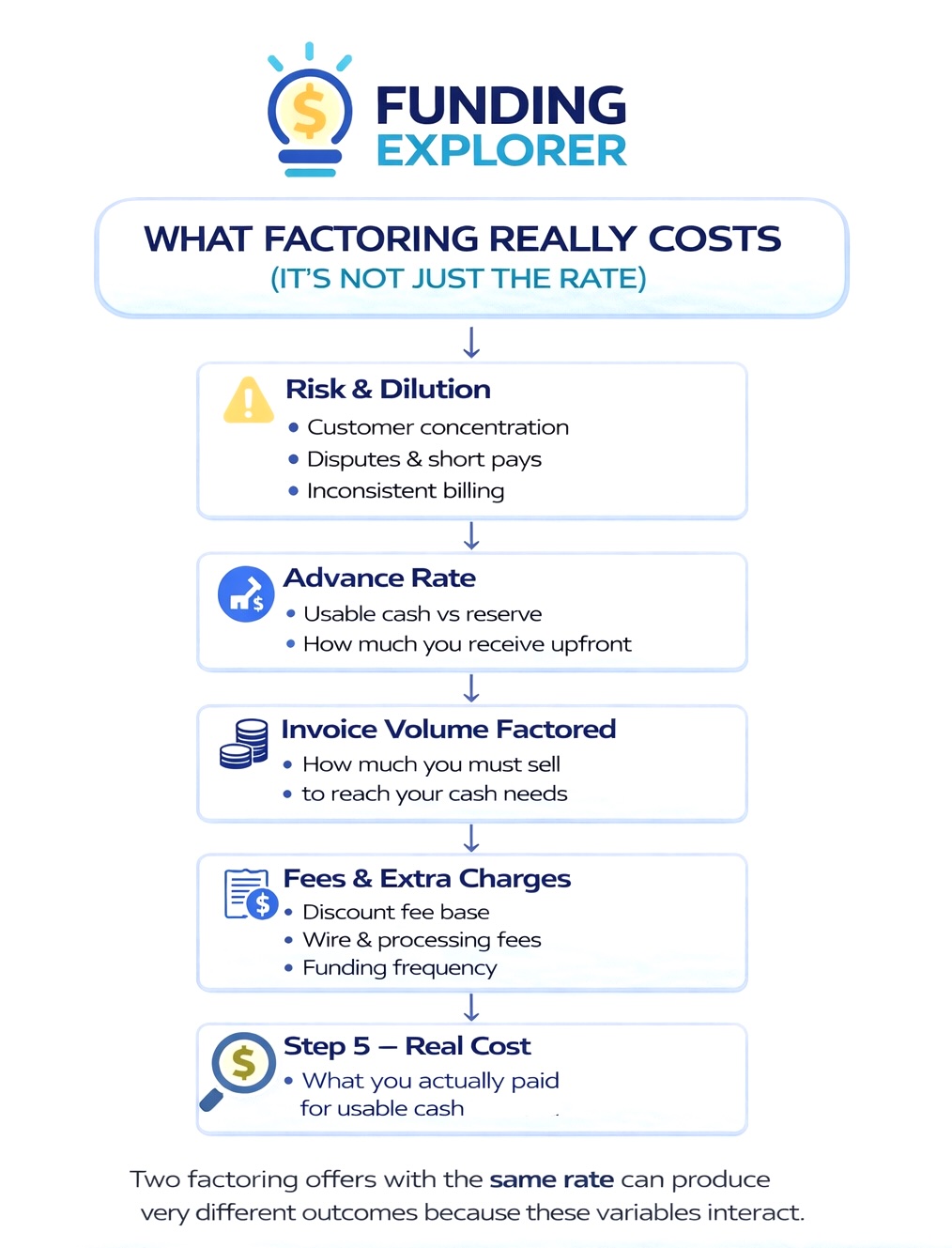
That disconnect exists because factoring doesn’t work like a loan. The rate is only one part of a larger system. What you really pay depends on how fees are calculated, how much cash you actually receive, how risk affects advances, and how the structure of the agreement fits your business.
To understand what factoring really costs, you have to look at how all of these pieces interact.

The Most Common Mistake: Comparing Factoring to a Loan
When businesses compare factoring offers, they usually compare percentages.
2.25% versus 2.75%.
3.00% versus 3.25%.
It feels logical to assume the lower rate is cheaper. But factoring isn’t priced on borrowed cash. It’s priced on receivables’ face value and sometimes on advances, which changes how costs show up in practice.
Two companies can receive the same quoted rate and still experience very different outcomes. In many cases, the business with the lower rate ends up paying more over the year.
To see why, you first need to understand what factoring fees are actually charged on.
What Factoring Fees Are Charged On (And Why This Varies)
Factoring fees are not calculated the same way in every agreement.
In many traditional factoring structures, fees are charged on the full invoice amount, regardless of the advance. In other structures, often selective or short-term arrangements, fees may be charged on the amount advanced instead.
Both models exist. Neither is inherently better.
What matters is understanding which base your fee is applied to, because that determines how advances, volume, and funding frequency affect your real cost.
The amount a factoring fee is calculated on. Some agreements charge on the full invoice value, others on the amount actually advanced. The same percentage produces different costs: 2.5% on a $100,000 invoice is $2,500, while 2.5% on a 90% advance of the same invoice is $2,250.
What that difference is worth
Take the identical rate, 2.5%, and apply it two ways at a 90% advance:
- Charged on invoice value: 2.5% of $2,200,000 = $55,000 a year
- Charged on the amount advanced: 2.5% of $1,980,000 = $49,500 a year
The same number in the same font costs $5,500 a year more depending on one preposition in the contract. That is an 11% difference in your annual financing cost, and it is invisible in the quote.
It also means a lower advertised rate can be the more expensive one. A 2.4% fee charged on invoice value costs $52,800, while a 2.6% fee charged on the advance costs $51,480. The rate that is two tenths of a point higher is $1,320 a year cheaper.
This variation is one of the main reasons comparing factoring offers can be confusing.
The same 2.5% fee, applied two ways. $2.2 million factored a year, 90% advance.
| What the fee is charged on | The calculation | Per year |
|---|---|---|
| Invoice value | 2.5% of $2,200,000 | $55,000 |
| The amount advanced | 2.5% of $1,980,000 | $49,500 |
| Difference | One preposition in the contract | $5,500 |
The Rate Structure: Why Your Advertised Rate Is Rarely What You Pay
Factoring rates come in three shapes, and the page you were quoted from usually shows only the first number of whichever one you were given.
- Flat. One percentage, regardless of when the customer pays. Predictable, and more expensive when customers pay quickly.
- Tiered. A base rate covers an initial period, usually 30 days, and then the rate steps up for each additional period. This is the most common structure in the market.
- Daily. A rate accruing per day outstanding, which behaves like a fine-grained tier.
The advertised number on a tiered offer is the price for the first period. If your customers pay in 30 days, that is the price you pay. If they pay in 50, it is not.
A factoring rate that starts at a base percentage for an initial period, usually 30 days, then increases by a set increment for each additional period. It is the most common structure in factoring. The advertised rate is the price for the first period only.
Tiered rates are steps, not slopes
This is the part that surprises people who have been factoring for years. A tiered rate does not drift upward as your customers get slower. It sits flat, sits flat, and then jumps a full increment the moment you cross a boundary.
Take a common structure: 1.8% for the first 30 days, plus 0.6% for each additional 10 days.
| Customers pay on | Rate actually charged | Annual cost |
|---|---|---|
| day 30 | 1.8% | $39,600 |
| day 31 to 40 | 2.4% | $52,800 |
| day 41 to 50 | 3.0% | $66,000 |
| day 51 to 60 | 3.6% | $79,200 |
| day 61 to 70 | 4.2% | $92,400 |
The offer that advertised 1.8% charges 3.6% to a business whose customers pay in 55 days. Nothing has gone wrong. That is the schedule working as written.
Which is cheaper depends entirely on your collection period
The same tiered offer against a flat 3.0%. Which one is cheaper reverses across a fifteen-day range:
| Customers pay in | Tiered offer | Flat 3.0% offer | Cheaper |
|---|---|---|---|
| 40 days | $52,800 | $66,000 | Tiered, by $13,200 |
| 50 days | $66,000 | $66,000 | Identical |
| 55 days | $79,200 | $66,000 | Flat, by $13,200 |
Same two offers, same business, and which one is better reverses across a fifteen-day range of customer behavior you do not control.
This is also why “we average about 50 days” is not enough information. What decides your price is where each individual invoice lands relative to the boundaries, not where the average lands. Two businesses with the same average collection period can pay materially different amounts.
If your customers are slow or unpredictable, a flat rate is worth asking for. If they pay quickly and reliably, a tiered rate will usually beat it. The only way to know which describes you is to price both structures against your own collection data.
When you are comparing two tiered offers against each other, the boundaries sit in different places and the answer can reverse over a single day. We work that through in How to Compare Two Invoice Factoring Offers.
The fourth structure: a small rate plus an interest rate
Since 2022, factoring agreements filed with the SEC increasingly split the price in two: a small factoring fee plus a separate finance fee tied to Prime or another variable rate, often with a floor beneath it.
Every row below is a real contract on file with the SEC:
| Agreement | Factoring fee | Finance fee |
|---|---|---|
| Recruiter.com, April 2022 | 0.575% + 0.30% per 15 days | Prime + 3.25%, 6.75% floor |
| EPI Health, December 2022 | 0.35% per 30 days | Prime + 2.00%, 8.25% floor |
| High Wire Networks, January 2023 | 0.45% + 0.25% per 15 days | Prime + 1.75%, 9.25% floor |
| bluebird bio, December 2023 | 0.05% | Prime + 1.35% |
A 0.05% rate is not comparable to a 2.5% one. The headline got dramatically smaller and the total cost did not, because the interest-style finance fee sits beside it and is charged on funds outstanding. If a proposal quotes you a rate below about 1%, the rate is not the price. Find the second number.
Notice how the floors track the signing date: 6.75% in April 2022, 8.25% that December, 9.25% the following January, following the Fed upward. A floor locks in the factor's minimum yield. If Prime falls below it, the factor keeps the difference and you do not benefit.
Why Advance Rates Still Matter, No Matter How Fees Are Charged
Even though fees can be charged on different bases, advance rates still play a critical role in determining real cost.
The advance controls how much usable cash you receive for the fee you’re paying. When advances are lower, more of your money is held back in reserve. When advances are higher, more cash is available immediately.
Let’s look at a simple comparison.
Invoice: $100,000
Rate: 2.25%
Fee Charged on Invoice Amount
- Fee: $2,250
- 80% advance → $80,000 cash
- 90% advance → $90,000 cash
Same fee. Different funding outcome. Different Effective Cost.
Total fees divided by the cash actually received, rather than by invoice face value. A $2,250 fee on a $100,000 invoice is 2.50% against a 90% advance and 2.81% against an 80% advance. It is the only figure comparable across two different agreements.
| Advance | Fee |
Cash Received |
Effective Cost on Cash |
|---|---|---|---|
| 80% | $2,250 | $80,000 | 2.81% |
| 90% | $2,250 | $90,000 | 2.50% |
Fee Charged on Amount Advanced
- 80% advance → fee on $80,000 = $1,800
- 90% advance → fee on $90,000 = $2,025
The fee base changes, but the core issue remains: lower advances mean less usable cash per transaction.
In both models, advance rates directly influence how much funding you receive and how much volume you need to factor to meet your cash needs.
How Advances Change the Real Cost, Even at the Same Rate
When advances are lower, businesses often need to:
- factor more invoices, or
- factor larger volumes, or
- factor more frequently
All of these increase total fees over time, even when the rate stays the same.
For example, if a business needs $90,000 in cash each month:
- At an 80% advance, it must factor $112,500
- At a 90% advance, it only needs to factor $100,000
Same cash needed. Same rate. Different factoring volume.
Over a year, that difference alone can translate into thousands of dollars in additional fees, regardless of whether fees are charged on invoices or advances.
Run that across a year. Say the business needs $1,980,000 of cash over twelve months, at a 2.25% fee charged on invoice value:
- At a 90% advance, it factors $2,200,000 and pays $49,500
- At an 80% advance, it factors $2,475,000 and pays $55,688
$6,188 a year more, at the identical rate, for the identical cash in hand.
The advance rate is not a convenience feature. It is a price.
Why Advance Rates Differ: Risk and Dilution
Advance rates are not arbitrary. They are driven by perceived risk.
Anything that makes collections less predictable reduces advances, including:
- customer concentration
- invoice disputes or credits
- short payments
- inconsistent billing
- spot or one-off factoring
This is often referred to as dilution, the gap between what is invoiced and what is ultimately collected.
Higher dilution risk means:
- lower advances
- more cash held in reserve
- less usable cash upfront
Lower dilution risk supports:
- higher advances
- less reserve
- better access to your own cash
Risk doesn’t just affect pricing. It affects how much funding you can actually use.
The Hidden Impact of “Small” Extra Fees
In addition to the main factoring fee, many agreements include ancillary charges such as:
- wire or ACH fees per funding
- transaction or processing fees
- monthly minimums
- lockbox or account maintenance fees
Individually, these fees look minor. But their impact depends on how often you fund and how much cash you receive each time.
When advances are lower or funding is more frequent, these small fees consume a larger percentage of usable cash. Over time, they materially increase the real cost of financing.
This is why businesses factoring smaller amounts more frequently often feel that costs add up faster than expected, even when rates appear competitive.
What the stack actually comes to
The fee schedule, at 8 fundings and 40 invoices in a busy month:
| Fee | Rate | Per year |
|---|---|---|
| Wire transfers | $20 per funding | $1,520 |
| Invoice processing | $7.50 per invoice | $2,640 |
| Monthly admin | $500 a month | $6,000 |
| Total | $10,160 |
Compare an all-in 2.5% offer against a 2.3% offer carrying that schedule:
- 2.5% all-in: $55,000 a year
- 2.3% plus the schedule: $50,600 plus $10,160 = $60,760 a year
The rate went down two tenths of a point and the bill went up $5,760.
Two things worth noticing in that table. The wire fees, the item everyone asks about, are the smallest line. And the largest line, the flat monthly admin fee, is the one that does not scale with your volume at all.
That last point inverts what most owners assume. Flat monthly fees land hardest on the smallest accounts. A $500 monthly fee is a rounding error against a $500,000 month and a serious cost against a $50,000 one. If you are a smaller business being told these fees are minor, they are minor to the factor, not to you.
The Minimum, and Why It Only Bites in the Months You Can Least Afford It
An agreement to factor a set amount each month. If you factor less, you pay the fee on the committed amount anyway. It affects seasonal and growing businesses most, because it only binds in the months volume is lowest.
Our business factors $2,200,000 a year, but not evenly. Seven months at $250,000 and five at $90,000. Against a $150,000 monthly minimum, those five slow months are billed at $150,000 each, so the factor charges on $2,500,000 of volume against $2,200,000 actually factored.
- 2.35% with no minimum: $51,700 a year
- 2.25% with a $150,000 minimum: $56,250 a year
The offer that is a tenth of a point cheaper costs $4,550 a year more, and every dollar of it arrives in the months when revenue is lowest.
Compare any minimum to your slowest month, never your average month. If your business is seasonal, project-based, or growing from a small base, this is the clause to read first.
One related structure to look for while you are there: some factors also set the rate by volume, so it drops as you factor more. A seasonal business can fall into a worse rate band in exactly the months a minimum starts biting. The two clauses look unrelated on the page, and they punish the same months.
Why Structure Multiplies or Reduces Cost
Factoring structure ties everything together.
- Spot factoring concentrates risk, often leading to lower advances and higher effective costs.
- Selective factoring allows businesses to match funding to actual needs, controlling volume and fees.
- Full ledger factoring can reduce risk and improve advances but increases the total volume factored.
None of these structures is inherently good or bad. The cost outcome depends on how well the structure aligns with your cash flow patterns.
Factoring more invoices than necessary, even at a lower rate, often increases total cost without creating additional value.
Why a Higher Rate Can Sometimes Be Cheaper
Six levers. In each one, the offer with the lower advertised rate ends up costing more.
| The lever | The "cheaper" offer | The one that actually costs less | Costs you per year |
|---|---|---|---|
| Fee basis | 2.4% on invoice value | 2.6% on the advance | $1,320 |
| Rate structure | 1.8% tiered, customers pay in 55 days | 3.0% flat | $13,200 |
| Advance rate | 2.25% at an 80% advance | 2.25% at a 90% advance | $6,188 |
| Fee schedule | 2.3% plus per-item fees | 2.5% all-in | $5,760 |
| Minimum | 2.25% with a $150,000 minimum | 2.35% with none | $4,550 |
| Termination | 2.25% on a 12-month term | 2.50% month to month | $10,083 if you leave at month 5 |
Six different mechanisms, six different ways the lower number loses. You cannot tell which one is sitting in your proposal by reading the rate, because in every row the rate is the thing pointing the wrong way.
A higher rate combined with a higher advance can result in:
- less volume factored
- fewer funding transactions
- lower total annual fees
Meanwhile, a lower rate paired with a lower advance can force a business to factor more just to reach the same cash target. This is why comparing rates without understanding advances and fee bases often leads to the wrong decision.
The Rate You Cannot Leave
A lower rate is only a saving for as long as the arrangement still suits you. Contract terms commonly run 12 months, with 30 to 90 days’ notice, and early termination penalties commonly quoted as one to three months of average fees.
Take a 2.25% offer on a 12-month term against a 2.50% offer month to month. The lower rate saves about $458 a month.
Then something changes, as it does. You lose a large customer, your volume moves, or a better facility appears.
You need to leave at month five.
| Amount | |
|---|---|
| Saved by month 5 (about $458 a month) | $2,292 |
| Cost to leave (3 months of average fees) | $12,375 |
| Net position | minus $10,083 |
You would need to stay well past two years for that rate saving to cover a single exit. And the penalty is not the whole cost, because for those months you also could not act.
Termination clauses vary enormously in how they are written, and the wording decides everything. Ask the factor directly what it would cost to leave in month five, and get the answer in writing. If it takes more than one sentence to explain, that itself is worth knowing before you sign.
How to Think About Your Real Factoring Cost
Instead of asking, “What’s the rate?” a better set of questions is:
- On what amount is the fee charged?
- How much cash do I actually need each month?
- What advance will I receive?
- How much invoice volume must I factor to reach that cash amount?
- How often will I fund, and what extra fees apply?
Those answers determine real cost far more than the advertised percentage.
Those questions describe what to look for. Applying them to two live proposals, with a full fee schedule on each and twelve months of your own seasonality, is a longer job.
We have written that up as a step-by-step method: How to Compare Two Invoice Factoring Offers, worked through a full example where the offer advertising 1.8% costs $25,760 a year more than the one advertising 2.5%.
Final Thought
Factoring cost is not just a percentage.
It’s the interaction between fee structure, advances, risk, and usable cash. When you understand that interaction, factoring becomes a strategic tool instead of a confusing expense.
If you’re evaluating factoring options, clarity on these mechanics can make the difference between a smart funding decision and an expensive surprise.
Frequently Asked Questions
Is a tiered or a flat factoring rate better?
Neither is better in the abstract. A tiered rate is cheaper when customers pay quickly and more expensive when they do not. On $2.2 million of annual volume, a tiered offer is $13,200 cheaper than a flat 3.0% at 40 days, identical at 50 days, and $13,200 more expensive at 55 days.
Why does the same factoring rate cost different amounts?
Because the rate is a percentage of something, and agreements differ on what. The same 2.5% fee charged on invoice value costs $55,000 a year on $2.2 million of volume and $49,500 charged on a 90% advance. An 11% difference from one preposition in the contract.
What is a factoring minimum volume commitment?
A commitment to factor a set amount each month or pay the fee on that amount regardless. It clears easily in an average month, which is why it looks harmless. Compare it to your slowest month: a seasonal business can be billed on $2,500,000, having factored $2,200,000.
What decides factoring cost besides the rate?
Six separate mechanisms can make the lower advertised rate the more expensive offer: the fee basis, the rate structure, the advance rate, the fee schedule, minimums, and early termination. Each is worked through above with annual figures.
Sources
The pricing examples in this article are drawn from factoring agreements filed as exhibits with the U.S. Securities and Exchange Commission. These are executed contracts, not published rate cards.
- bluebird bio / Alterna Capital Solutions, December 2023, 0.05% factoring fee plus Prime + 1.35%, non-recourse, 90% advance
- Recruiter.com Group / Bay View Funding, April 2022 , 0.575% first 30 days, +0.30% per 15 days, plus Prime + 3.25% with a 6.75% floor
- Meade Instruments Amended and Restated Factoring and Security Agreement, 2012, 75% advance generally, 50% on Costco invoices
- Cordia Corp / Thermo Credit, 2007, non-recourse with chargeback at 120 days, 4% termination fee
- Grand Toys / Montcap Financial, 2001, 2.0% flat discount
Complete agreements can be searched at EDGAR full-text search.
Analia Miguel is an MBA and former CPA with 20+ years in business finance and marketing, including 14 years in alternative business finance. She helps business owners understand their funding options and choose cash flow solutions that truly fit their needs.
Last Updated: July 28th, 2026
Factoring Fundamentals
Factoring Cost Insights
You've seen how the costs work. Now run yours.
Your invoice volume, your offer terms, every fee counted, one true, all-in number.