
How to Compare Two Invoice Factoring Offers (Step by Step)
Quick Summary
This article is a step-by-step method for comparing two invoice factoring proposals. Most comparisons stop at the advertised rate, which is one of at least seven variables that decide what you actually pay.
Working through a full example, we show two offers where the one advertising 1.8% costs $25,760 a year more than the one advertising 2.5%. Both offers are built from pricing structures taken from real factoring agreements filed with the SEC. The point is not that low rates are traps. It is that the rate alone cannot tell you which offer is cheaper, and in this example the answer changes depending on something as small as your customers paying one day later.
Why You Cannot Compare Factoring Offers on the Rate
You have two offers on your desk.
One quotes 1.8%. The other quotes 2.5%. You have a business to run; both companies seem professional, and one is asking for nearly a full point less than the other.
Most people sign the 1.8%.
In the comparison below, that decision costs $25,760 a year and then $21,290 to get out of. Not because anyone lied. Every term is written in the agreement, disclosed in the fee schedule, and standard for the industry.

The Business in This Example
The Two Offers
These are not invented structures. Both are drawn from factoring agreements filed as exhibits with the Securities and Exchange Commission, which is the only place complete factoring agreements are publicly readable.
- Offer B’s pricing, 1.8% for the first 30 days plus 0.6% for each additional 10 days, is within five hundredths of a point of the agreement Phunware signed with Bay View Funding, which charged 1.80% for the first 30 days plus 0.65% per 10 days.
- Offer A’s step interval, 0.25% every 15 days, is exactly what High Wire Networks agreed with Bay View in 2023 , and close to the 0.30% per 15 days in Recruiter.com’s 2022 agreement.
- Offer B’s fee schedule ($10 ACH, $20 domestic wire, $50 international) is Bay View’s standard schedule, unchanged across every filed agreement from 2016 to 2023.
Both are tiered, which is the dominant structure in these agreements: a base rate covers an initial period, then the rate steps up for each additional period the invoice stays unpaid.
The two proposals, side by side:
| Offer A | Offer B | |
|---|---|---|
| Advertised rate | 2.5% for the first 30 days | 1.8% for the first 30 days |
| Then | +0.25% every 15 days | +0.60% every 10 days |
| Fee charged on | the amount advanced | the full invoice value |
| Advance rate | 90% | 82% |
| Wire fee | none | $20 per funding |
| Invoice processing | none | $7.50 per invoice |
| Monthly admin fee | none | $500 |
| Minimum | none | $150,000 a month in volume |
| Origination fee | $500 | none |
| Term | month to month | 12 months, 60 days notice |
Step 1: Normalize the Fee Basis
The amount a factoring fee is calculated on. Some agreements charge on the full invoice value, others on the amount actually advanced. The same percentage produces different costs: 2.5% on a $100,000 invoice is $2,500, while 2.5% on a 90% advance of the same invoice is $2,250.
Taking both base rates at face value, on $2.2 million of annual volume:
- Offer A charges on the 90% advanced, so 2.5% of $1,980,000 = $49,500
- Offer B charges on the full invoice value, so 1.8% of $2,200,000 = $39,600
Offer B is still well ahead, but the gap has narrowed from $15,400 to $9,900 on the strength of one preposition in the contract.
Step 2: Price the Rate Structure Against How Your Customers Actually Pay
A factoring rate that starts at a base percentage for an initial period, usually 30 days, then increases by a set increment for each additional period. It is the most common structure in factoring. The advertised rate is the price for the first period only.
At 50 days:
- Offer A: 2.5% plus two 15-day steps of 0.25% = 3.00%
- Offer B: 1.8% plus two 10-day steps of 0.60% = 3.00%
The two offers charge exactly the same rate. A 0.7 point advertised difference has vanished entirely, because B’s steps are more than twice as steep and arrive 50% more often.
And since the two rates are now identical, the fee basis from step 1 decides everything:
- Offer A: 3.00% of $1,980,000 = $59,400
- Offer B: 3.00% of $2,200,000 = $66,000
Offer B is now the more expensive of the two, by $6,600 a year. Same rate, different base.
The Boundaries Sit in Different Places
A tiered rate is a step function, not a sliding scale. It holds a price for a fixed window, then jumps a whole increment at the boundary. We work through that mechanic on its own in What Factoring Really Costs.
What matters here is what happens when you put two of them side by side. Each offer steps on its own schedule, so their boundaries land on different days, which means which offer is cheaper depends on where your collection period happens to fall.
Here is the same two offers priced across the range:
The same two offers, priced across the range. Annual cost on $2.2 million factored.
| Customers pay on | Offer A | Offer B | Cheaper |
|---|---|---|---|
| day 30 | 2.50% ($49,500) | 1.80% ($39,600) | B, by $9,900 |
| day 35 to 40 | 2.75% ($54,450) | 2.40% ($52,800) | B, by $1,650 |
| day 41 to 45 | 2.75% ($54,450) | 3.00% ($66,000) | A, by $11,550 |
| day 46 to 50 | 3.00% ($59,400) | 3.00% ($66,000) | A, by $6,600 |
| day 51 to 60 | 3.00% ($59,400) | 3.60% ($79,200) | A, by $19,800 |
| day 61 and beyond | 3.25% ($64,350) | 4.20% ($92,400) | A, by $28,050 |
Read the two highlighted rows together.
If your customers pay on day 40, Offer B is cheaper. If they pay on day 41, Offer A is cheaper. That single day swings the answer by $13,200 a year.
Nothing in either contract changed. Nobody renegotiated. One customer started taking an extra day, and the better offer became the worse one.
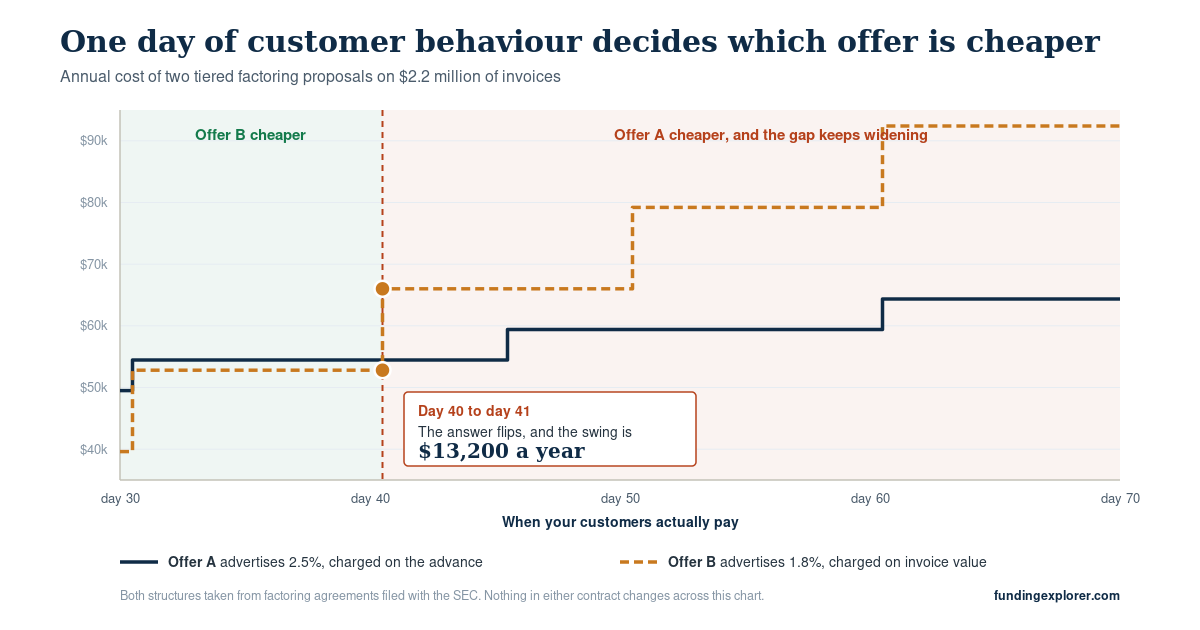
Two things follow from this:
“We average about 50 days” is not enough information. Two agencies can both average 50 days and pay different amounts, because what matters is where each individual invoice lands relative to the boundaries, not where the average lands. Averages hide exactly the thing that decides the price.
Neither of these offers is better than the other in the abstract. Offer B genuinely is cheaper for a business whose customers pay quickly. Offer A is cheaper for one whose customers do not. There is no way to know which you are without knowing your own collection data, and the answer can change as your customer mix changes.
Step 3: Add the Full Fee Schedule
Offer B charges $20 per wire, $7.50 per invoice processed, and $500 a month in admin fees. That wire fee is not an estimate: $20 domestic and $50 international is Bay View Funding’s standard schedule, identical in every one of its agreements on file from 2016 through 2023.
None of those is a number you would negotiate over. Together, at this agency’s funding frequency and invoice count, they come to $10,160 a year.
- Offer A: $59,400
- Offer B: $76,160
The gap is now $16,760.
Note where the money is. The wire fees, the item everyone asks about, are the smallest piece at $1,520 a year. The monthly admin fee is the largest at $6,000, and it is the one that does not change with your volume at all.
The charge that is larger than all of these
Worth knowing while you are reading a fee schedule. Nearly every agreement in the SEC filings carries a penalty of 10% of an invoice’s full face value if a payment is misdirected, an invoice is invalid, or a required notation is missing. Two of them charge 15%.
On this agency’s average invoice, that is $625 for a single misdirected payment, which is 41% of its entire annual wire bill. A misdirected payment simply means your customer paid you instead of the factor’s lockbox, which happens routinely in the first months of a facility while customers update their remittance details.
We cover this in detail in Hidden Factoring Fees. For comparison purposes, note only that it exists in both offers and is not in either total below.
Step 4: Test the Minimum Against Your Slow Season
An agreement to factor a set amount each month. If you factor less, you pay the fee on the committed amount anyway. It affects seasonal and growing businesses most, because it only binds in the months volume is lowest.
Offer B requires $150,000 a month in factored volume. In the five slow months this agency only has $90,000, so it pays the fee on $150,000 anyway.
That shortfall costs $9,000 a year.
- Offer A: $59,400
- Offer B: $85,160
Compare any minimum to your slowest month, never your average. An average month clears almost every minimum, which is exactly why the minimum looks harmless on the page.
Minimums are also close to universal in the filed agreements, and occasionally negotiable: High Wire Networks had its monthly minimum explicitly waived in a 2023 amendment. It is worth asking.
The running total
Adding one variable at a time. Annual cost on $2.2 million factored, customers paying in 50 days.
| What you have accounted for | Offer A | Offer B | Which is cheaper |
|---|---|---|---|
| The advertised rate only | $55,000 | $39,600 | B saves $15,400 |
| + fee basis | $49,500 | $39,600 | B saves $9,900 |
| + rate structure | $59,400 | $66,000 | B costs $6,600 more |
| + fee schedule | $59,400 | $76,160 | B costs $16,760 more |
| + minimum volume | $59,400 | $85,160 | B costs $25,760 more |
Two notes so you can check this. These are recurring fees only: Offer A’s $500 origination fee is one-time and is not included, which, if anything, understates the gap in Offer B’s favor. And the totals blend seven busy months with five slow ones, so no monthly figure is simply one twelfth of the annual.
The next three steps do not change the cost total. They test things the total cannot see.
Step 5: Convert to Effective Cost on the Cash You Actually Receive
Total fees divided by the cash actually received, rather than by invoice face value. A $2,250 fee on a $100,000 invoice is 2.50% against a 90% advance and 2.81% against an 80% advance. It is the only figure comparable across two different agreements.
In a busy month at this agency:
- Offer A: $6,750 in fees on $225,000 of cash = 3.00%
- Offer B: $8,460 in fees on $205,000 of cash = 4.13%
The offer advertising 1.8% costs 4.13%. The offer advertising 2.5% costs 3.00%.
If you take one number from this article, take that one. It is the only figure in a factoring proposal that means the same thing across two agreements, and it is never the number you are quoted.
Step 6: Compare Usable Cash, Not Just Cost
Cost is not the only thing an agreement decides. The advance rate decides how much of your own money you can actually use.
On a $250,000 month, Offer A puts $225,000 in the account on day one. Offer B puts $205,000.
That $20,000 is not lost. The reserve is released when your customer pays. But it is not available in the week you are making payroll, which for a staffing agency is the entire reason the facility exists.
Keep this separate from the cost comparison. It is a working capital question, not a fee question, and blending them produces numbers you cannot defend.
Step 7: Read the Exit Before You Read Anything Else
This is the step people skip, and it is the one that removes your ability to fix the other six.
Offer A is month to month. Leaving costs nothing.
Offer B runs 12 months with 60 days’ notice. Suppose you work all of this out at month five and want to leave. What that costs depends entirely on how one clause is written, and the filed agreements show all of these structures in live use:
You want to leave at month five of a twelve-month term. What that costs:
| How the termination clause is written | Cost to leave | Seen in |
|---|---|---|
| Month to month (Offer A) | $0 | Grand Toys, 30-day notice |
| 1 month of average fees | $7,097 | common in published guides |
| 3 months of average fees | $21,290 | common in published guides |
| Every remaining month at the minimum | $31,500 | Recruiter.com, Phunware, High Wire (all filed) |
That last row is not a worst case anyone invented. Bay View’s agreements with Recruiter.com and Phunware both charge 0.50% of maximum credit multiplied by the months remaining on early termination, and High Wire’s charges 0.25% on the same basis. Cordia’s 2007 agreement charged 4% of the total purchase commitment.
Same business, same exit date, and the bill ranges from nothing to $31,500 depending on wording you did not read because it was on page nine.
Ask the factor exactly what it costs to leave in month five. If the answer takes more than one sentence, get it in writing.
Two other things to check while you are in that section: how long the notice period is, since 60 days’ notice means deciding two months before you want out, and whether the agreement auto-renews if you miss that window.
"But My Proposal Doesn't Have Those Fees"
Probably true. It may have three others instead.
There is no standard fee schedule in factoring. Some agreements charge invoice processing fees, and some do not. Admin fees may be monthly, quarterly, or absent. This is exactly why you cannot learn what your agreement costs by reading an article about someone else’s.
So it is fair to ask how much of the conclusion depends on fees your proposal might not have. Here is the same comparison with them stripped out one at a time:
The same comparison with each fee removed in turn:
| What Offer B is charged | Offer B per year | Still more than Offer A by |
|---|---|---|
| The full fee schedule | $85,160 | $25,760 |
| No invoice processing fee | $82,520 | $23,120 |
| No monthly admin fee | $79,160 | $19,760 |
| Wire fees only | $76,520 | $17,120 |
| No ancillary fees at all | $75,000 | $15,600 |
Take every ancillary fee out of Offer B, and it still costs $15,600 a year more. The fee basis, the rate structure, and the minimum do that on their own, and all three appear in nearly every agreement.
Two structures this example leaves out
Volume-tiered pricing, where the rate itself drops as your monthly volume rises: 2% at $50,000 a month, 1.5% at $150,000, and 1.2% at $300,000. Worth finding in your own proposal, because a seasonal business can fall into a worse rate band in its slow months at the same time a minimum volume commitment starts biting. Those two clauses look unrelated on the page, and they punish the same months.
Unbundled, interest-indexed pricing. Since 2022 the filed agreements increasingly split the price into a small factoring fee plus a separate finance fee tied to Prime, often with a floor. Recruiter.com pays 0.575% plus Prime + 3.25% with a 6.75% floor. bluebird bio pays a factoring fee of 0.05% plus Prime + 1.35%. A 0.05% rate is not comparable to a 2.5% one, and the difference is not a discount. If your proposal quotes a rate under about 1%, look for the second number.
It Does Not Take Big Differences
Baseline: Offer A at $59,400 a year.
| One small change | Why you would not fight it | Costs you per year |
|---|---|---|
| Fee charged on invoice value, not the advance | Same rate. One word. | $6,600 |
| Base rate of 2.65% instead of 2.50% | 0.15 of a point. | $2,970 |
| Tier steps of 0.40% instead of 0.25% | Fifteen hundredths of a point, once. | $5,940 |
| Customers pay day 61 instead of day 60 | One day. | $4,950 |
| Wire fee of $30 instead of $20 | Ten dollars. | $760 |
| A $350 monthly admin fee | Under $12 a day. | $4,200 |
| Minimum volume of $165,000 instead of $140,000 | You factor $250,000 anyway. | $3,750 |
| All seven together | Nothing worth a phone call. | $29,170 |
That is 49% more than the baseline, assembled entirely out of terms you would skim past.
For a staffing agency, $29,170 is a part-time administrator’s salary. It is the difference between hiring someone and deciding you cannot afford to yet.
Are You Even Comparing the Same Product?
One last check, because it invalidates everything above if you get it wrong.
A non-recourse offer at 2.0% is not simply cheaper than a recourse offer at 2.4%. Non-recourse means the factor absorbs the loss if your customer fails to pay for credit reasons, and the premium plus credit-check charges usually pushes the all-in cost above the recourse offer.
Read what the non-recourse actually covers, too. Cordia’s 2007 non-recourse agreement still allowed the factor to reject and charge back any invoice unpaid at 120 days, which is a meaningful limit on the protection being sold.
That does not make it the wrong choice. If you have real customer concentration or a customer whose credit worries you, buying that protection may be exactly right. But it is a different product, and comparing its rate to a recourse rate is comparing an insured price to an uninsured one.
Price both, then decide whether the protection is worth what it costs.
Proposal, Agreement, or Both? What You Are Actually Comparing
Three documents get called offers, and the difference decides how much you can actually see.
A quote is indicative pricing, usually a rate and an advance rate. A proposal is the short document a factor sends after a real conversation, setting out the headline terms. An agreement is the full contract, often ten or more pages, carrying the complete fee schedule, the penalty provisions, and the exact termination formula.
Signing a proposal does not commit you. It moves you into underwriting and document preparation. When the agreement arrives, you can read it, question it, and decline it. Plenty of businesses do.
Which means you can be in one of three positions:
- Two proposals. You are shopping. Both sides show headline terms only.
- Your current agreement against a new proposal. You are renewing or looking at switching.
- Two agreements. You are switching, and the new factor has sent documents. This is the most complete comparison available to anyone.
The trap in the middle one
If you are already factoring and comparing your existing agreement to a new proposal, you are not comparing like with like, and the asymmetry favors the new offer every time.
You know your current costs precisely, because you have been paying them. Every wire fee, every processing charge, the month the minimum bit. On the new proposal you can see a rate and an advance rate, and nothing else. Comparing the two puts a fully costed year against a headline, and the headline will always look better.
The fix is simple: ask for the agreement. You can read a factoring agreement without signing it, and it is the only document with all the terms in it. A factor who will not send one until you have committed is telling you something.
If you cannot get the full agreement, ask specifically for the fee schedule, the termination clause, and the minimum. Those three are where the difference usually is.
Your Turn
For each of your two offers, write down:
- What is the fee charged on? Invoice value, or the amount advanced.
- What is the tier structure? The base rate, the size of each step, and how often a step arrives. Then calculate the rate at your real collection period, not at 30 days.
- Where are the boundaries? Find the day each offer steps up. If your collection period sits just before one, a small slip in customer behavior changes your price.
- What is the full fee schedule? Separate them into per invoice, per funding, flat monthly, one-time, and penalty. Multiply each by how often it will actually happen.
- Is there a minimum, and is the rate volume-banded? Compare both to your slowest month, not your average.
- What is the effective cost on cash received? Total fees divided by cash actually advanced.
- What does it cost to leave in month five? And how much notice is required?
If both offers come out close after that, you have made a real comparison, and either choice is defensible.
Where This Gets Hard
Seven variables, two agreements, twelve months, a slow season, and an answer that changes if your customers pay a day later. Done properly on paper, that is an afternoon and a spreadsheet you will not trust by the end of it.
It is also the comparison no factoring company will build for you. Every factor has a calculator for its own offer. None of them will run it beside a competitor’s, because there is no version of that tool that is good for their business.
Funding Explorer is not a factoring company, is not owned by one, and earns nothing on the deal you choose. That is the only reason this comparison exists at all.
The quick estimate on the simulator page will take you through the first pass: your advance rate, your fee, your payment terms, your day-one cash, your cash flow week by week, and a two-offer comparison on rate and advance. It also tells you on screen what it is leaving out, because at that depth it has to.
The full simulator runs both complete agreements on your real invoices, with every fee, the fee basis, the tier structure, the minimum, the recourse terms, and the exit clause all modeled, and gives you the difference in dollars for each one.
That was somebody else’s agreement. Run yours.
Frequently Asked Questions
Does the factoring offer with the lower rate always cost less?
No. The advertised rate is one of at least seven variables that set your cost. In the example above, an offer advertising 1.8% costs $25,760 a year more than one advertising 2.5%, because of the fee basis, the tier structure, the fee schedule and a minimum volume commitment.
What is the effective factoring rate?
The effective rate is your total fees divided by the cash you actually received, not by the invoice face value. It is the only figure that means the same thing across two agreements. In the example above, an offer advertising 1.8% has an effective rate of 4.13%.
How do I compare two factoring offers?
Normalize the fee basis, price each rate structure against your real collection period, add the full fee schedule, test any minimum against your slowest month, convert both to effective cost on cash received, compare usable cash, and read the termination clause before anything else.
Can two factoring offers with different advertised rates cost exactly the same?
Yes, and it is common with tiered pricing. In the example above, one offer advertises 2.5% and the other 1.8%, but at a 50-day collection period both charge 3.00%. The 0.7 point difference exists only at 30 days, which is not when these customers pay.
What is the difference between a factoring proposal and a factoring agreement?
A proposal is a short document setting out the headline terms: the rate, the advance, the reserve, and the recourse period. An agreement is the full contract, often ten or more pages, containing the complete fee schedule and penalty provisions. Signing a proposal does not commit you. You can read the agreement and decline it.
What does it cost to exit a factoring contract early?
It depends entirely on how the clause is written. On a twelve-month term exited at month five, the same business faces $0 month to month, $7,097 at one month of average fees, $21,290 at three months, or $31,500 where the agreement charges every remaining month at the minimum, a structure that appears in several agreements filed with the SEC.
Sources
The offer structures, fee schedules, and termination clauses in this article are taken from factoring agreements filed as exhibits with the U.S. Securities and Exchange Commission. These are executed contracts, not published rate cards.
- Phunware / Bay View Funding factoring agreement , 1.80% first 30 days, +0.65% per 10 days, 80% advance
- High Wire Networks / Bay View Funding, Amendment No. 3, January 2023 , 0.45% first 30 days, +0.25% per 15 days, 90% advance, monthly minimum waived
- Recruiter.com Group / Bay View Funding, April 2022, 0.575% first 30 days, +0.30% per 15 days, early termination at 0.50% of maximum credit per month remaining
- Cordia Corp / Thermo Credit, 2007, non-recourse with chargeback at 120 days, 4% termination fee
- bluebird bio / Alterna Capital Solutions, December 2023, 0.05% factoring fee plus Prime + 1.35%
Complete factoring agreements can be searched at EDGAR full-text search.
Analia Miguel is an MBA and former CPA with 20+ years in business finance and marketing, including 14 years in alternative business finance. She helps business owners understand their funding options and choose cash flow solutions that truly fit their needs.
Last Updated: July 28th, 2026
Factoring Fundamentals
Factoring Cost Insights
You've seen how the costs work. Now run yours.
Your invoice volume, your offer terms, every fee counted, one true, all-in number.