Factoring Costs Beyond the Rate: What Really Adds Up
Summary
This article explains one component of invoice factoring costs.
Factoring cost depends on more than the rate and advance. Other fees, sometimes called “hidden fees,” driven by how factoring is used, including funding frequency, invoice volume, and account structure, can significantly affect total cost over time.
This article teaches which costs matter and offers a simple way to evaluate factoring proposals based on real business needs.
How Much Do Factoring Fees Really Add to Your Cost?
When businesses compare factoring offers, they usually focus on two numbers: the factoring rate and the advance rate.
That makes sense. Those are the most visible parts of a proposal, and they feel like the primary drivers of both cost and cash access. But many businesses are surprised later when their total factoring cost doesn’t align with what those two numbers seemed to suggest.
The reason is simple: factoring costs are not defined solely by the rate and advance.
Beyond those headline figures, factoring agreements often include additional charges tied to how often you fund, how many invoices you submit, and how the account is structured. These costs are not hidden in the sense of being secret; they are disclosed in the contracts you sign, but they are often not fully modeled when proposals are compared.
In some cases, these additional costs can increase the effective cost of factoring by another 0.5% to 1% or more annually, depending on how the facility is used.
That range holds for a mid-size account. It understates the position for a small one.
On a business factoring $250,000 a month, a schedule of wire, processing, and monthly admin fees comes to about 0.38% of volume a year. On a business factoring $50,000 a month, the same schedule comes to 1.28%, because most of those fees do not shrink when your volume does.
Measured the way it actually lands against what you pay in factoring fees rather than against your sales, the schedule adds 10% for a large account and 51% for a small one.
Understanding these costs doesn’t mean factoring is expensive or unfair. It means the structure needs to match how your business actually operates.
A Clarification About Factoring “Hidden Fees”
You’ll often see non-rate factoring costs described online as “hidden fees.” That language has largely come from factoring companies or invoice financing companies trying to differentiate themselves from competitors.
In reality, most of these fees are not hidden.
They are typically:
- outlined in the factoring agreement,
- disclosed in fee schedules or exhibits,
- and agreed to when the contract is signed.
The actual problem isn’t “hidden costs”; it’s context.
These fees are rarely highlighted in initial quotes, and their impact is often not projected based on real usage. That’s why businesses are sometimes surprised later, even though the fees were technically disclosed.

More Factoring Fees Do Not Necessarily Mean Higher Final Factoring Costs
It’s also important to be clear about this: more fees do not automatically mean a higher total cost.
Some factoring companies charge:
- lower discount rates, but
- more usage-based fees
Others charge:
- higher rates, but
- fewer additional charges
Either factoring fee structure can be cheaper depending on how often you fund, how much you factor, and how consistent your cash needs are.
That’s why numbers matter more than labels.
Worked through a business factoring $2.2 million a year:
- A 2.5% all-in offer with no additional charges: $55,000 a year
- A 2.3% offer plus $20 a wire, $7.50 an invoice and $500 a month: $50,600 in rate, $10,160 in fees, $60,760 a year
- Here the extra fees do win: the rate came down two tenths of a point, and the bill went up $5,760.
But reverse the usage and the answer reverses. A business factoring the same volume across a quarter of the invoices, funding monthly instead of weekly, pays far less on that schedule, and the 2.3% offer becomes the cheaper one.
Neither pricing model is better. The answer depends on how you fund and only on that.
Why the Same Fee Schedule Costs a Small Business Five Times More
One fee schedule ($20 domestic wire, $7.50 an invoice, $500 a month admin, Bay View's filed schedule), applied across four business sizes:
| Monthly volume | Fee schedule per year | Factoring fee at 2.5% | The schedule adds |
|---|---|---|---|
| $50,000 | $7,680 | $15,000 | 51% |
| $100,000 | $8,400 | $30,000 | 28% |
| $250,000 | $11,520 | $75,000 | 15% |
| $500,000 | $15,120 | $150,000 | 10% |
The same schedule adds 51% to a small account's factoring bill and 10% to a large one. Small businesses are routinely told these charges are minor. They are minor to the factor.
Why: most of these fees do not scale with your volume.
| $50,000 a month | $500,000 a month | |
|---|---|---|
| Wire fees | $960 | $1,920 |
| Invoice processing | $720 | $7,200 |
| Monthly admin | $6,000 | $6,000 |
Volume goes up tenfold. The admin fee does not move at all, and wire fees only double, because a business funding weekly funds weekly whether it is small or large. Only invoice processing genuinely tracks size. That $500 monthly fee, on its own, is 40% of what a $50,000-a-month business pays in factoring fees.
The Main Categories of Factoring Costs Beyond the Factoring Rate
Not every agreement includes all of these fees. What matters is understanding which ones apply to your usage pattern.
One-Time Setup and Onboarding Costs
These costs cover the initial setup work for your factoring account.
This category includes fees like the following:
- setup or onboarding fees
- due diligence or credit review fees
- legal or documentation charges
These costs typically matter more for short-term relationships and less for long-term facilities.
The reason they matter for short arrangements and not long ones is arithmetic.
Why setup fees matter for short arrangements and not long ones. A $1,500 setup fee:
| If you factor for | Effective cost per month |
|---|---|
| 3 months | $500 |
| 6 months | $250 |
| 12 months | $125 |
| 24 months | $62 |
If you are bridging a short gap, a setup fee is one of the larger costs you will carry. If you are factoring for years, it is close to irrelevant.
Variable Fees Per-Funding Transfer
These are among the most common recurring costs and often have the biggest real-world impact.
For example:
- ACH transfer fees (commonly $5–$15 per funding)
- wire transfer fees (often $20–$50 per funding)
These fees apply each time funds are sent, not based on invoice size. Businesses that fund frequently will feel these costs more than businesses that fund occasionally.
At $20 a wire, Bay View’s filed rate, a business funding weekly, pays $960 a year. One funding twice a week pays $1,920. This is the one fee driven purely by how often you draw, not by how much.
Worth asking: is ACH free, and is same-day funding charged differently from standard? Both are common and neither usually appears in the quote.
Variable Per-Invoice or Processing Fees
Some factors charge fees tied to invoice handling rather than the funding amount.
For example:
- invoice processing fees
- transaction or submission fees
- lockbox or payment processing charges
These matter most to businesses that submit many small invoices.
At $7.50 an invoice, a business submitting 40 invoices a month pays $3,600 a year. The same volume delivered as 8 larger invoices pays $720.
This is the only fee on the page that genuinely tracks the size of your business, and it is driven by your invoice count, not your revenue. Two businesses with identical volume can be $2,880 a year apart on this line alone.
Recurring Monthly Maintenance or Service Fees
These are flat or semi-flat charges related to account maintenance.
Examples:
- monthly service fees
- account management charges
- reserve maintenance fees
They apply no matter how much is factored every month.
A $500 monthly fee is $6,000 a year regardless of whether you factored $50,000 or $500,000.
That makes this the most size-sensitive charge in the entire schedule. On a $500,000-a-month account, it is 4% of the factoring fee. On a $50,000-a-month account, it is 40%. If you are being told a monthly fee is small, check it against your own fee total rather than against theirs.
Conditional Minimum Volume or Minimum Fee Charges
Some agreements require:
- a minimum monthly factoring volume, or
- a minimum monthly fee
If the minimum isn’t met, the difference is charged. For businesses that consistently meet volume, these fees rarely apply.
Compare any minimum to your slowest month, never your average. An average month clears almost every minimum, which is exactly why the clause reads as harmless.
A business factoring $250,000 in busy months and $90,000 in slow ones, against a $150,000 minimum, is billed on $2,500,000 of volume, having factored $2,200,000. We work that through in What Factoring Really Costs .
Situational Payment-Timing and Dilution-Related Fees
Some factoring agreements include additional costs if collections take longer than expected, invoices become delinquent, or short payments are received.
For example:
- extended aging charges
- rate step-ups after a set number of days
- fees related to charge-backs, disputes, credits, or short payments
These are tied to customer behavior and billing quality. We’ve covered dilution and its impact on cost in depth in a separate article, but it’s an important variable to keep in mind here.
Rate Step-ups are the Largest Number on This Page
Most factoring rates are tiered: a base rate for the first 30 days, then a step up for each additional period. The advertised rate is the price for the first period only.On a business factoring $2.2 million a year, a single step of 0.6% is $13,200 a year. That is more than the wire fees, the processing fees and the monthly admin fee combined.And a step is not gradual. A tiered rate sits flat, sits flat, then jumps the whole increment the moment your collection period crosses a boundary. An offer advertising 1.8% charges 3.6% to a business whose customers pay in 55 days. Nothing has gone wrong when that happens. It is the schedule working as written.Because it is triggered by customer behavior rather than anything in your control, this is the one line in the fee schedule that can change what you pay without anyone renegotiating anything. The full mechanics are in What Factoring Really Costs.The Charge That Dwarfs Every Fee on This Page
Almost every factoring agreement on file with the SEC carries a penalty of 10% of an invoice’s full face value for a misdirected payment, an invalid invoice, or a missing notation on the invoice. Two of the agreements we reviewed charge 15%.It is not a percentage of the fee. It is a percentage of the whole invoice.A misdirected payment penalty is 10% of the invoice’s full face value, not 10% of the fee:| On an invoice of | The penalty is |
|---|---|
| $6,250 | $625 |
| $25,000 | $2,500 |
| $100,000 | $10,000 |
A misdirected payment is not exotic. It means your customer paid you instead of the factor’s lockbox. That happens routinely in the first months of a facility while customers update their remittance details, and it happens again whenever a customer changes accounting systems or staff.
This is the one line in a fee schedule worth negotiating hardest and worth building a process around. Ask what the cure period is, whether the penalty is waived if you forward the payment within a set number of days, and whether it applies per invoice or per occurrence.
Termination or Buyout Fees (Exit-Related)
These only apply if a business exits the factoring relationship early.
For example:
- penalties for early termination
- buyout dependent on the amount of time left or the factored volume
These fees are particularly significant when you need flexibility or are planning to use factoring for short-term financing.
Penalties are commonly quoted as one to three months of average fees, on terms that usually run 12 months with 30 to 90 days’ notice.
Early termination at three months of average fees, which is the common upper end:
| Monthly volume | All-in annual cost | Cost to exit |
|---|---|---|
| $50,000 | $22,680 | $5,670 |
| $100,000 | $38,400 | $9,600 |
| $250,000 | $86,520 | $21,630 |
| $500,000 | $165,120 | $41,280 |
The exit fee scales with your all-in cost, not your rate. Every fee elsewhere in the schedule also raises the price of leaving. Ask exactly what it would cost to leave in month five, and get the answer in writing.
Factoring Fee Impact by Usage Pattern
| Fee Category | Matters Most When… | Often Minimal When… |
|---|---|---|
| Funding & Transfer Fees | Funding is frequent or same-day transfers are common | Funding is less frequent and scheduled |
| Invoice & Processing Fees | Many small invoices or high transaction volume | Fewer, larger invoices with simple documentation |
| Monthly & Minimum Fees | Usage is inconsistent or seasonal | Volume is consistent and predictable |
| Timing & Dilution Fees | Customers pay late or invoices are disputed | Receivables pay consistently within terms |
| Setup & Exit Fees | Factoring is short-term or flexibility is critical | Factoring is long-term and stable |
Two businesses. Identical $250,000 monthly volume, identical fee schedule, identical contract.
| Business A | Business B | |
|---|---|---|
| Invoices a month | 40 (average $6,250) | 10 (average $25,000) |
| Fundings a month | 8 (weekly, split runs) | 2 |
| Wire fees a year | $1,920 | $480 |
| Processing fees a year | $3,600 | $900 |
| Monthly admin a year | $6,000 | $6,000 |
| Fee schedule total | $11,520 | $7,380 |
$4,140 a year apart, decided entirely by invoice count and funding frequency. This is why a proposal cannot be priced without knowing how you operate, and why two businesses using the same factor can honestly report different costs.
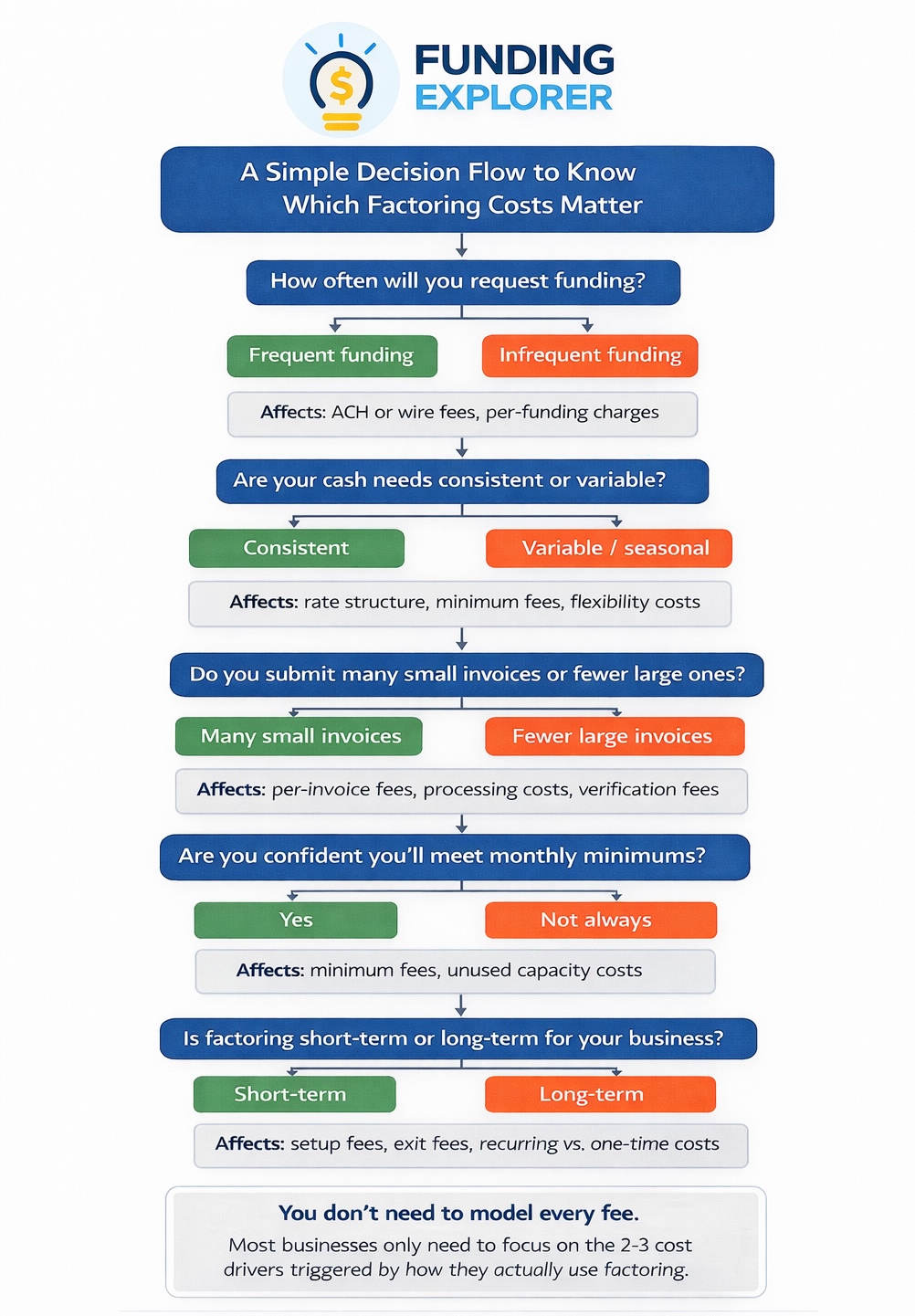
A Simple Decision Flow to Know What Actually Matters
Instead of trying to account for every possible fee, start with these questions:
1. How often will you request funding?
If funding is frequent, then transfer and processing fees matter more.
2. Are your cash needs consistent or variable?
If your needs are consistent, then the rate structure and advances matter more.
If you have variable needs, then flexibility and minimums matter more.
3. Are you selling many small invoices or a few large ones?
If the invoice amounts are small, the per-invoice fees can be significant.
4. Are you confident that you will be able to meet any minimums?
If you usually meet the minimums, these fees may never apply.
If you are not sure, then these fees should be modeled in your evaluation.
5. Is this short-term or long-term financing?
If you will be factoring for a short term, then setup and exit fees matter more.
If you are planning to factor for the long term, then recurring costs are more important than one-time fees.
6. How large is your account relative to the flat fees?
Add up every fee that does not change with your volume, monthly admin, minimums, and service charges, and compare the total to what you expect to pay in factoring fees. If it is more than a fifth of that number, the flat fees are a bigger negotiating priority than the rate.
7. Is your rate tiered, and where are the boundaries?
Find the day your rate steps up, then compare it to your real average collection period. If the boundary sits within a few days of where your customers actually pay, a small slip in their behavior changes your price by more than any fee on this page.
Most businesses only need to analyze two or three of these variables to estimate their real cost.
Once you know which of these apply to you, the next job is putting two live proposals side by side.
We have written that up as a step-by-step method: How to Compare Two Invoice Factoring Offers.
Frequently Asked Questions
How much do factoring fees add to the cost beyond the rate?
It depends on your size, far more than most guides admit. The same schedule of wire, processing, and monthly admin fees adds about 10% to the factoring bill of a business factoring $500,000 a month and about 51% for one factoring $50,000 a month.
Which factoring fees cost small businesses the most?
Flat monthly fees, because they do not shrink when your volume does. A $500 monthly admin fee is 4% of what a $500,000-a-month business pays in factoring fees and 40% of what a $50,000-a-month business pays. Identical fee, ten times the relative cost.
What happens if my customer pays me instead of the factor?
Most agreements call that a misdirected payment and charge a penalty of 10% of the invoice’s full face value, not 10% of the fee. On a $6,250 invoice, that is $625. It is the largest per-event charge in a typical fee schedule, and it happens most often in the first months of a facility.
What is a rate step-up in a factoring agreement?
A tiered rate increase is triggered when an invoice stays unpaid past a set period, usually every 10, 15, or 30 days. On $2.2 million of annual volume, a single 0.6% step is $13,200 a year, more than wire, processing, and monthly admin fees combined.
Are factoring fees actually hidden?
No. They are disclosed in the agreement and in the fee schedule. The problem is context: they are rarely highlighted in the initial quote and almost never projected against how a specific business will actually use the facility, which is when their size becomes obvious.
Sources
The fee schedules in this article are taken from factoring agreements filed as exhibits with the U.S. Securities and Exchange Commission. These are executed contracts, not published rate cards.- Recruiter.com Group / Bay View Funding, April 2022, $10 ACH, $20 domestic wire, $50 international, $30 returned check, audits to $1,000 a day, 10% penalty on misdirected payments
- High Wire Networks / Bay View Funding, Amendment No. 3, January 2023, same schedule seven years on, monthly minimum waived
- Novan / EPI Health, December 2022, identical penalty and admin schedule
- Meade Instruments, 2012 , $2,000 monthly facility fee, 15% misdirected payment penalty
- Grand Toys / Montcap Financial, 2001, $10,000 application fee, $60,000 guaranteed lifetime discount revenue
Analia Miguel is an MBA and former CPA with 20+ years in business finance and marketing, including 14 years in alternative business finance. She helps business owners understand their funding options and choose cash flow solutions that truly fit their needs.
Last Updated: July 27th, 2026
Business Funding Expert Insights

Factoring Fundamentals
Factoring Cost Insights
You've seen how the costs work. Now run yours.
Your invoice volume, your offer terms, every fee counted, one true, all-in number.