
Factoring Reserves: What They Are and How They Work

Factoring reserves are often among the most complex aspects of the invoice factoring process to understand.
Many factoring websites provide simple descriptions of reserves, leaving you confused about where the money goes, when deductions occur, and what you actually receive.
We'd want to clarify this concept so you understand what a factoring reserve is, how it works, how reserve amounts are computed as payments arrive, and when balances are paid out.
What is a Factoring Reserve?
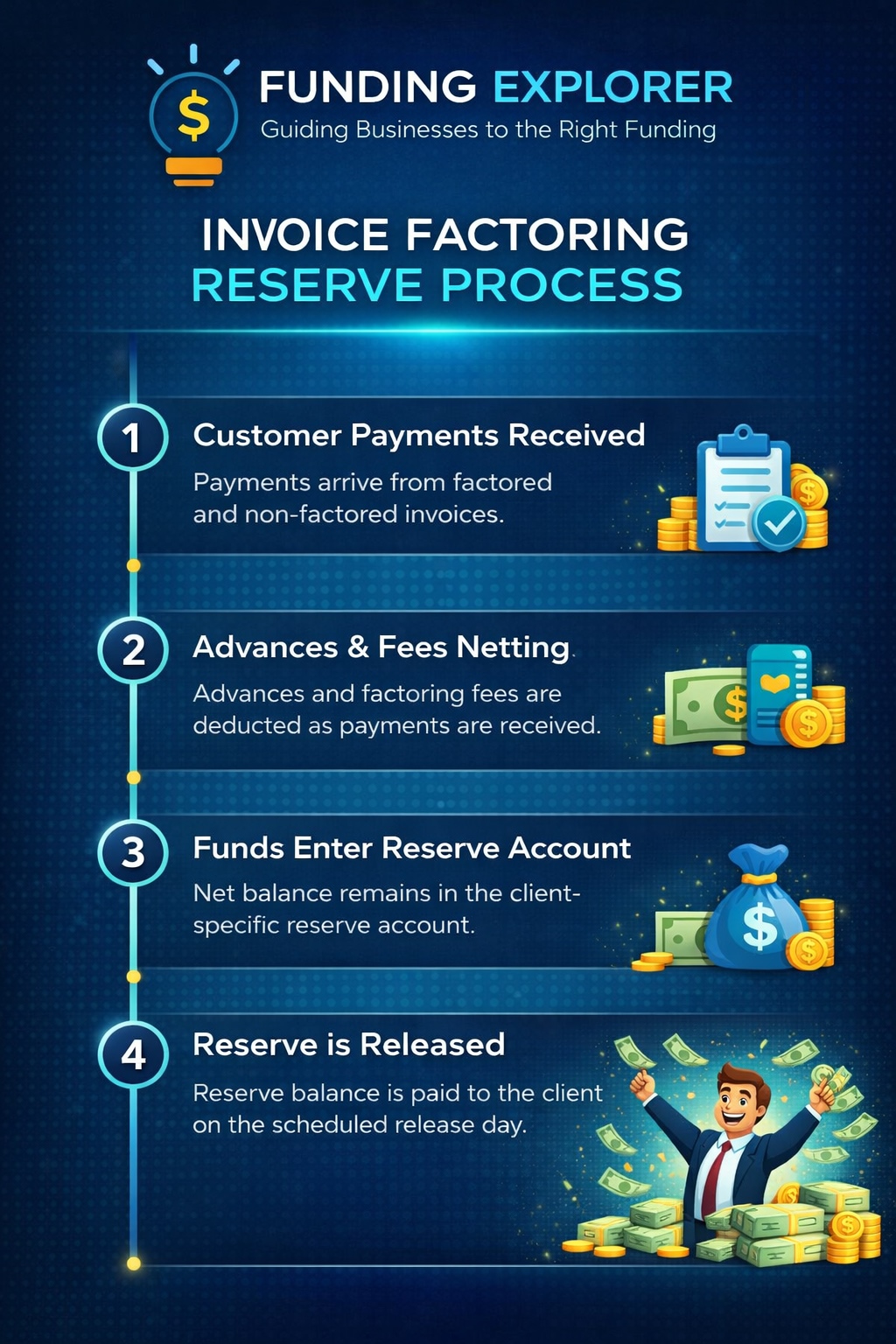
Reserve accounts typically retain payments for both factored and non-factored invoices. The balance is usually released once per week on a specific day.
Why do Factoring Companies Maintain Reserves?
Reserves help the factoring company handle payments efficiently while limiting financial risk.
Reserve accounts make it possible to:
- Net advances as soon as payments arrive
- Take fees right away.
- Cover short payments or chargebacks on overdue invoices.
- Reconcile activity before releasing the remaining balance.
Why do Factors Receive Payments on Non-Factored Invoices?
Most factoring agreements require clients to make payments to the factoring company for all invoices, regardless of whether they have been factored.
Payments on non-factored invoices, together with factored invoice payments, are deposited into the reserve account, included in the reserve balance, released according to the timetable, and used to cover any short pays, disputes, or chargebacks on factored invoices as needed.
This arrangement protects the factoring company because it makes funds from all sources available to cover offsets and adjustments.
How Factoring Reserves Work—Detailed Example
Acme Logistics is a factoring company client who has agreed on the following:
- Advance rate: 90%
- Factoring fee: 2% per factored invoice
Acme Logistics issues three invoices for services provided and factors two of the invoices:
- Factored Invoice #101: $8,000. Receives an advance of $7,200
- Factored Invoice #102: $12,000. Receives an advance of $10,800
The total advance paid upfront is $18,000
For this example, the reserve account starts with a balance of zero.
Acme Logistics bills clients on NET 30 terms. The following customer payments are received in the same week.
A payment for Factored Invoice #102 for $12,000 is received on Day 25
As soon as this payment is received, the factor:
- Reimburses the advance: $10,800
- Deducts the factoring fee (2% of $12,000): $240
The remainder is added to the reserve account: $12,000 − $10,800 − $240 = $960
Then the payment for one Non-Factored Invoice #201 for $5,000 is received on Day 27
The factor deposits the entire amount into the reserve account.
The reserve balance is now $960 + $5,000 = $5,960
The factor then:
- Deducts the factoring fee (2% of $8,000): $160
- Applies the remaining amount toward the advance and covers the shortfall with the reserve balance
Here’s the calculation
- Advance paid: $7,200
- Amount Collected: $3,000
- Uncovered advance shortfall covered with reserves: $4,200
After this transaction, the reserve balance is $5,960 − $4,200 = $1,760
Do you want to learn more?
We are here to help.
Factoring Reserves: FAQs
Analia Miguel is an MBA and former CPA with 20+ years in business finance and marketing, including 14 years in alternative business finance. She helps business owners understand their funding options and choose cash flow solutions that truly fit their needs.
Last Updated: January 7th, 2026
Invoice Factoring Expert Insights





Get Expert Guidance at No Cost
Cut through the noise and skip the confusion. Our experts, with over 20 years of experience in business finance, will match you with the factoring program that truly fits.